
I am going to be upfront about something. When people first hear about baby yoga, the image that tends to come to mind is a very photogenic infant doing downward dog on a miniature mat while soothing music plays in the background. And look, there are some genuinely adorable moments. I am not going to pretend otherwise. But baby yoga is not primarily an exercise in cuteness. It is a genuinely beneficial activity for both babies and their caregivers, and I want to explain why. Because I think a lot of parents dismiss it as a nice to have rather than a this is actually doing something. So here is what really happens in a session, and why each part of it matters.
First, who is it actually for?
Baby yoga is for babies and their caregivers together. You are both doing something, rather than you watching your baby do something, or your baby sitting in a bouncy chair looking mildly bewildered while you do something next to them.
At Nurtured Birth and Beyond, sessions are suitable from around 8 weeks old, once your GP, midwife or health visitor has given you the go ahead to start gentle movement. Babies can continue right through until they are confidently walking, but of course this varies a lot from baby to baby.
You do not need any experience. You do not need to be flexible. You do not need to have done any exercise since giving birth. This is genuinely not that kind of yoga. If you can sit on the floor and move your arms, you can do baby yoga.
What actually happens when you walk in
Sessions run for around an hour and a half. They are intentionally small groups, which means there is proper time to check in with everyone, make adjustments where needed, and actually build relationships with the other parents in the room.
We start with a welcome and a check in. How is everyone doing? How was the week? Did anyone sleep? That last one is always met with a few raised eyebrows.
This bit is not filler. It matters. You have probably spent most of the week in your own four walls and this is a chance to come up for air with people who genuinely get it.
Then we move into the session itself, which follows a consistent rhythm so that over time your baby starts to recognise it. Babies are big fans of predictability. It helps them feel safe and settled.
What the babies are doing
The movements we use with babies in a yoga session are specifically designed for their stage of development. They are gentle, they are supported, and they build progressively across the block of sessions.
A lot of what we do involves massage based strokes alongside movement. So you might be gently moving your baby's legs in a cycling motion while singing, which simultaneously stretches their hips, supports digestion and builds body awareness. Or you might be holding them in a supported seated position that gently strengthens their core. Or doing gentle movements that help with trapped wind, which if you have a baby with colic or reflux, you will have very strong feelings about.
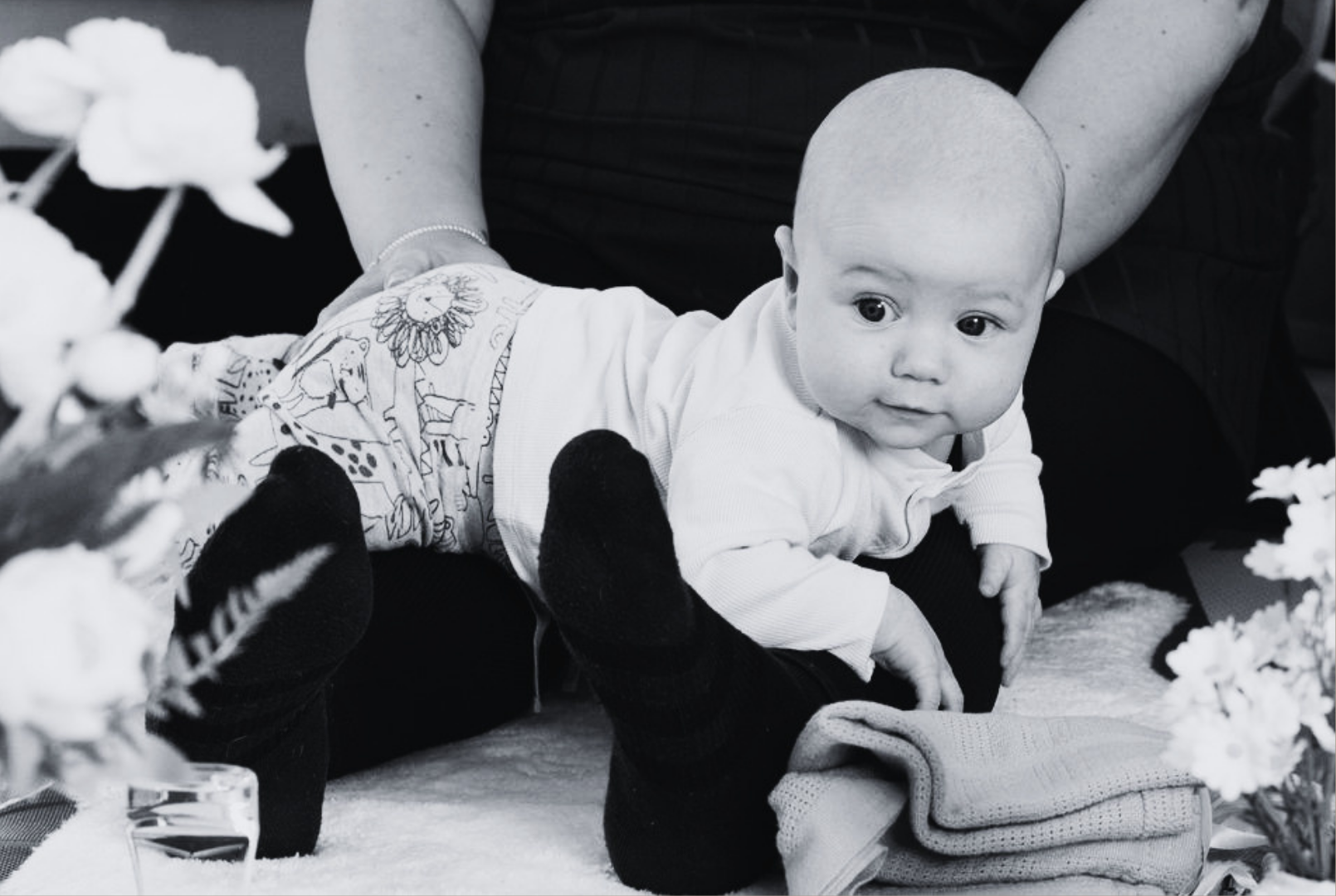
There is also tummy time woven throughout, but done in a way that makes it enjoyable rather than a battle. Most babies who protest tummy time on the mat are perfectly content when they are on your chest, supported on your legs, or engaged with something interesting in front of them. We work with that rather than against it. ¹
As babies get older and stronger, the movements evolve. We start introducing more weight bearing positions, supported standing and transitions that support their natural developmental progression. None of it is rushed or forced. Everything follows what your baby is showing you they are ready for.
What you are doing
While your baby is getting all of the above, you are doing something too.
The caregiver movements in baby yoga are gentle yoga flows specifically adapted for postnatal bodies. And your body has been through a lot. Your core has done something remarkable and is still recovering. Your posture has probably shifted significantly from months of feeding and carrying. Your shoulders and neck are very likely holding a lot of tension.
The movements we do address all of that. Gentle spinal mobility. Shoulder and chest opening. Core reconnection that starts from the inside out rather than the just do a crunch approach, which is absolutely not appropriate in the early postnatal period. ²
You are not going to leave a session dripping with sweat having done a workout. But over the course of a block, most parents notice a real difference in how their body feels. More mobile. Less tight. More aware of where they are holding tension without realising it.
And honestly, a this time each week, where you are doing something that feels good in your body is not a small thing. In a season of life that is often physically relentless, that matters.
The developmental bit, which is why it is not just cute
Let me get a bit more specific about what baby yoga actually does for your baby, because this is the part that tends to convince the sceptics.
Touch and movement are fundamental to infant development. In the early months especially, your baby is making sense of the world almost entirely through their body. The movement sequences in baby yoga support neurological development, the connections being built between your baby's brain and body. They support proprioception, which is your baby's awareness of where their body is in space. They support vestibular development, which is balance and spatial orientation. ³
The skin to skin contact and intentional touch also supports bonding and the release of oxytocin in both you and your baby. This is particularly relevant for parents who found the early weeks difficult, perhaps because of a difficult birth, a NICU stay, postnatal depression, or simply the fog of newborn exhaustion making it hard to feel connected. ⁴
Baby yoga gives you a structured, supported way to build that physical connection. And there is something really lovely about having a practice that belongs entirely to just you and your baby.
The community bit, which is arguably the most important bit
I will be honest. If you ask most parents what they loved most about baby classes six months down the line, it is not the specific movements they remember.
It is the people they met.
There is something about being in a room full of people who are all in the same season of life, all trying to figure it out, all a bit sleep deprived, all completely besotted with their little humans, that creates a bond pretty quickly.
The friendships that start in baby yoga classes tend to last. Coffee after the session turns into play dates. Play dates turn into a WhatsApp group. The WhatsApp group turns into actual proper friends who you can text at 2am when you cannot work out why the baby is crying again.
I do not think that is a small thing either. Isolation is one of the most common and least talked about experiences in early parenthood. Having somewhere to go each week, people who know your baby's name, a space where you are allowed to talk about how hard it actually is, that is genuinely valuable. ⁵
What a block looks like at Nurtured Birth and Beyond
My baby yoga sessions run in blocks, which means you book a set of 4sessions together rather than paying week by week. This is because we build on what we do each week and babies love that sense of predictability and rhythm. It also works for you because there is no trying to remember to rebook every week on no sleep.
Sessions are held at my studio in Cullercoats, right on the North Tyneside coast. The kind of location that makes the walk there and back feel like a small act of self care in itself.
Block 3 is forming now and I would love to have you join us. Drop me a message to get on the waitlist and I will be in touch with all the details.
Not sure if it is right for you?
Have a look at the sessions page or send me a message. I am always happy to have a chat about whether now is the right time for you both to join.
References
- Zachry, A.H. & Kitzmann, K.M. (2011). Caregiver awareness of prone play recommendations. ncbi.nlm.nih.gov/pmc/articles/PMC3010726
- Groom, T. et al. (2019). Postnatal exercise guidance. pelvicroar.org
- Srinivasan, S.M. et al. (2018). Effects of vestibular stimulation on motor development. ncbi.nlm.nih.gov/pmc/articles/PMC6052591
- Feldman, R. (2017). Oxytocin and social affiliation in humans. ncbi.nlm.nih.gov/pmc/articles/PMC5sign
- NCT (2018). Loneliness in new parenthood. nct.org.uk